
Please excuse me, I’ve been a little absent the last couple of weeks. I, like everyone else, am longing for spring! I’m ready for green grass, colorful birds, warm temperatures and sunshine, lots of sunshine! I’ve been keeping an eye on the Ruby-throated hummingbird migration map and they are SLOWLY making their way north. It’s a little slower than last year and I suspect that the cool temperatures and snowstorms that are hitting the central US are to blame for the slower migration. The weather forecast doesn’t look promising for it warming up either. I’m guessing that we won’t see any hummingbirds in our area until the mid to end of April. You can watch their progress by clicking here.
Today, I’d like to focus on a cute little bird that is a frequent guest in my backyard, the House Finch. House Finch’s were native to the western US but were accidentally introduced to the New York area in the 1940’s and have since populated the entire United States. Relatively small birds, they measure about 5 3/4″in height. Females and young finches have a rather plain brown face, blurry stripes all over their body and pale underparts; whereas males have a red eyebrow and forehead contrasting with brown cap. Their throat and head are red, lower underparts whitish, with dark stripes on the sides. House Finches are easily confused with their cousin, the Purple Finch.
They nest in a variety of deciduous and coniferous trees and on cactus and rock ledges. They also nest in or on buildings, using sites like vents, ledges, street lamps, ivy, and hanging planters. Occasionally House Finches use the abandoned nests of other birds. A House Finch’s nest is a cup made of fine stems, leaves, rootlets, thin twigs, string, wool, and feathers, with similar, but finer materials for the lining. Overall width of the nest is 3-7 inches, with the inside cup 1-3 inches across and up to 2 inches deep. The female lays a clutch of 2-6 eggs and incubates them for 13-14 days. A pair can have 1-6 broods of eggs depending on the climate where they live! The eggs are a pale blue to white color, speckled with fine black or pale purple.
House Finches eat primarily plant materials and seeds. They prefer black oil sunflower seeds over the larger striped sunflower seeds, millet and milo. If they happen to discover your backyard feeders, they could bring flocks of 50 or more friends over for dinner! I believe this fact because I have A LOT of them!

Female House Finch
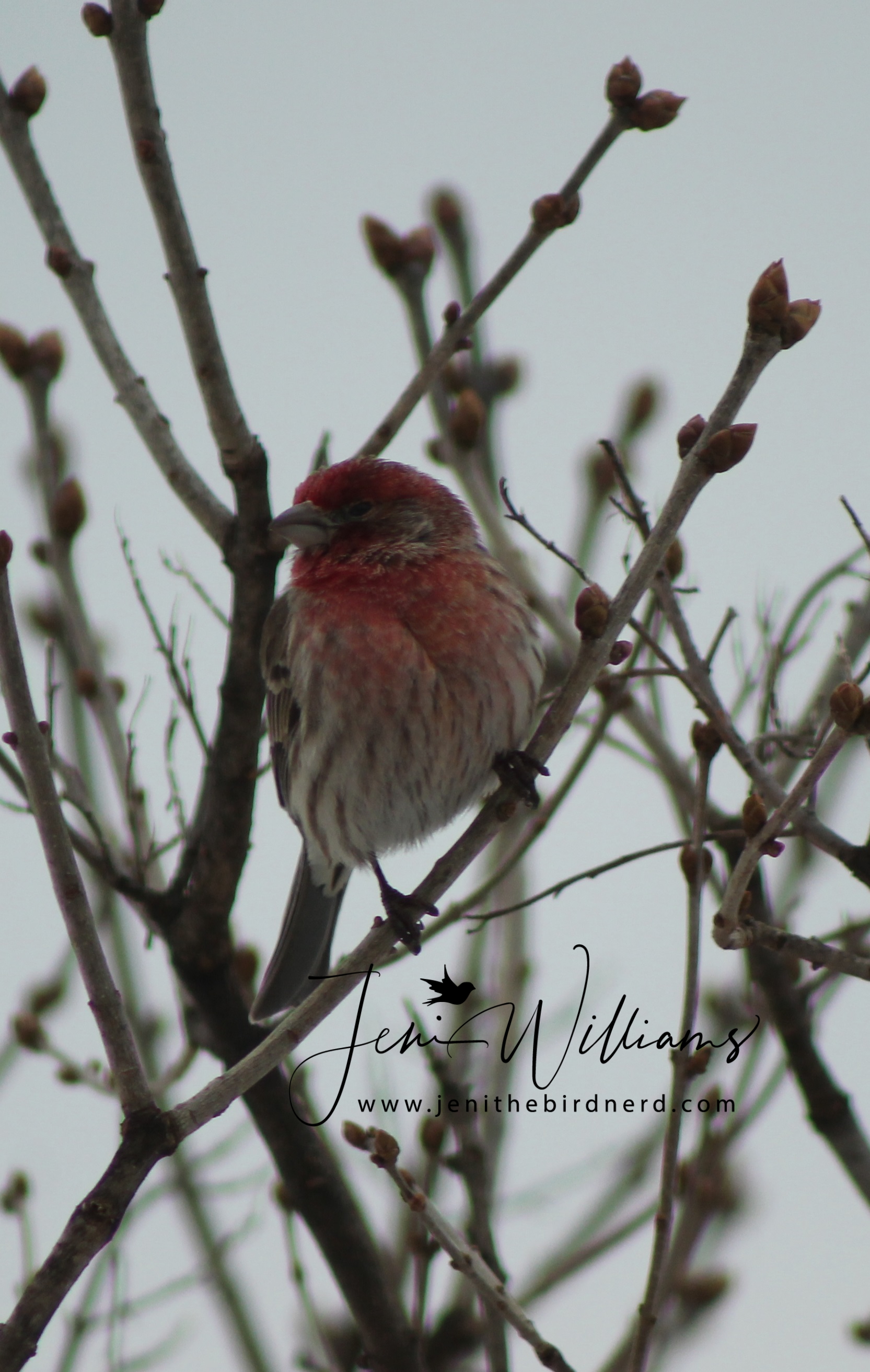
Male House Finch

